Revolutions
David First’s “Revolutions” is a large scale, long duration exploration of the drone.
Perhaps First explains it best: “…my best intention, and greatest hope, is to simply take you, the listener, to a place where you experience something beyond the daily, infinite cycles. Or better yet, tune you into them — all the way to the far-flung galaxies and back into your infinite bodily atoms and molecules. If you feel you can, trust us for an hour or so. Open yourself up and let us all in. Maybe you’ll find yourself on a journey of your own creation—your own story of discovery.”
And, as Sarah Hennies puts it in the liner notes: “There is technical rigor here, the result of a lifetime honing a highly personal compositional approach, but there is also levity and freedom, and the ability to lose oneself entirely in the work. “Revolutions” with its enveloping drones and surprising twists and turns of form gives the sense that one is more connected with where we come from but also hints at the wild surprises in the vast unknown.”
The music of “Revolutions” is based on the 16th through 32nd harmonics of the note G—a sound world that resides largely outside of traditional Western musical instruments and training. Three teams of players are required to execute these pitches in precisely timed cyclical rotations while also implementing mutes, bowing techniques, wah-wah pedals and electronic filters to create timbral micro-melodies. Further, the G pitched pulse heard in section three is beating at 91.875 bpm—a periodicity four octaves lower than the 49 Hz bass G frequency heard throughout.
Liner notes by Sarah Hennies and David First.
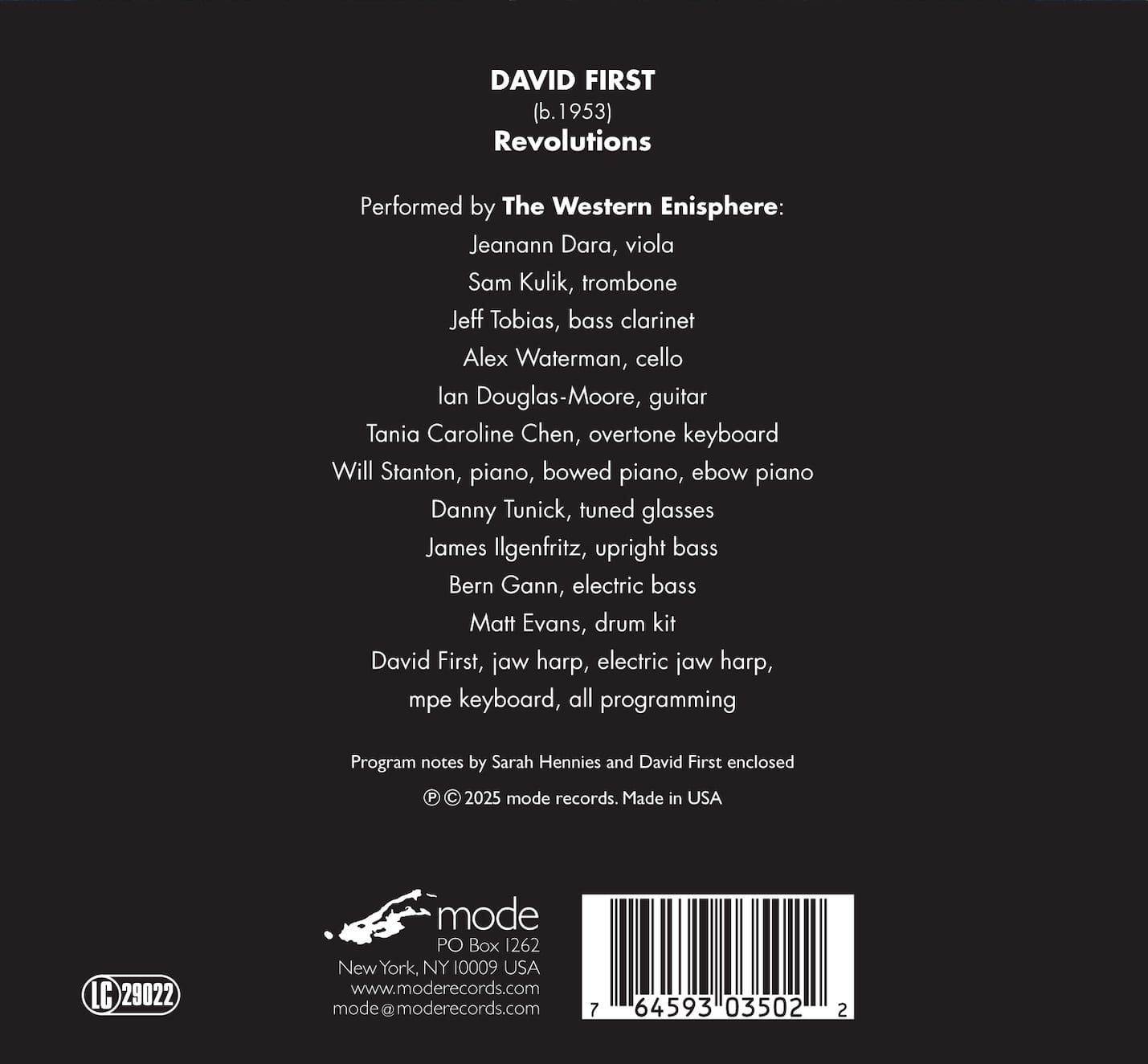
Performed by The Western Enisphere
Jeanann Dara, viola
Sam Kulik, trombone
Jeff Tobias, bass clarinet
Alex Waterman, cello
Ian Douglas-Moore, guitar
Tania Caroline Chen, overtone keyboard
Will Stanton, piano, bowed piano, ebow piano
Danny Tunick, tuned glasses
James Ilgenfritz, upright bass
Bern Gann, electric bass
Matt Evans, drum kit
David First, jaw harp, electric jaw harp, mpe keyboard, all programming
Reviews
While most chose to ignore the grey sky throughout the day I’ve found that it’s presence contains many aspects of that color; it is as if these essays for a moment circles all across a spectrum which faintly transitions, giving anyone listening an opportunity to unveil this: a view that never stays quite in focus as its too enticing to let go.
I own a cinder block wall outback and what he’s composed passes through each and every line it contains, connecting those points into a fabric.
This is the latest example from a collective corner who are called The Western Enisphere. First not only hones these surrealistic pieces he is also a member of T.W.E., how’s that for a twist. I’ve been following his work for quite a while and one thing which doesn’t intrude is the word predictable. In many ways what can or cannot be quantified is where he likes to venture towards.
Be it either examining one instrument or conducting an orchestra David’s arrangements truly posses the ability to stay outside those rules which so many chose to accept. In the nineteen eighties there were many similar sounds being used by more than a few artists and as revolving seemed to be the norm this guy avoided that trap; peruse ‘Electronic Works 1976-1977’ if you’d like to hear what he was up to far before those knockoff’s started spiting out their odious flings.
These releases being put out by under one name (that would be Mr. First) with so many abstracted frontiers are indeed a body of work; these are revolutions that are underway and sprawling.
This circumference cannot be calculated.
— Peter Marks, Santa Sangre Magazine, 18 November 2025, https://santasangremagazine.wordpress.com/2025/11/18/david-first-revolutions/
In her perceptive liner note essay for this monumental new work by guitarist and composer David First, fellow composer-performer Sarah Hennies explains her encounter with Revolutions as “a feeling not unlike my time spent in record stores and music libraries as a teenager, suddenly confronted with a massive universe I hadn’t yet been aware of but was always there waiting to be discovered.” That’s because First has built a music career through instinctive discovery and curiosity, moving from the Philadelphia no-wave band the Notekillers through free improvisation, electronic music, minimalism, and an abiding interest in the physicality of sound. In recent years, he’s deftly blended those interests within music written for his ensemble The Western Enisphere—whose disparate membership mirrors the composer’s disregard for stylistic purity—with Revolutions establishing a new apotheosis. Composed using just intonation, the work deploys a specific set of harmonics in G, colliding the visceral fury of rock music with the meditative longform harmonies of contemporary music. First is a composer who has long rejected hierarchies and canon, following his gut to generate a heady drone that hides within its static form a swirling, sparkling movement, as the various ensemble voices engage in a slow glide through microtonal sequences. A monolithic organ tone functions as a prismatic foundation, a molasses-slow churn of shifting textures, kaleidoscopic beating patterns, radiating harmony, penetrating pulsations, and psychoacoustic wonder, a sonic ant colony billowing under an unassuming mound of sound.
— Peter Margasak, Bandcamp Daily, 6 November 2025