

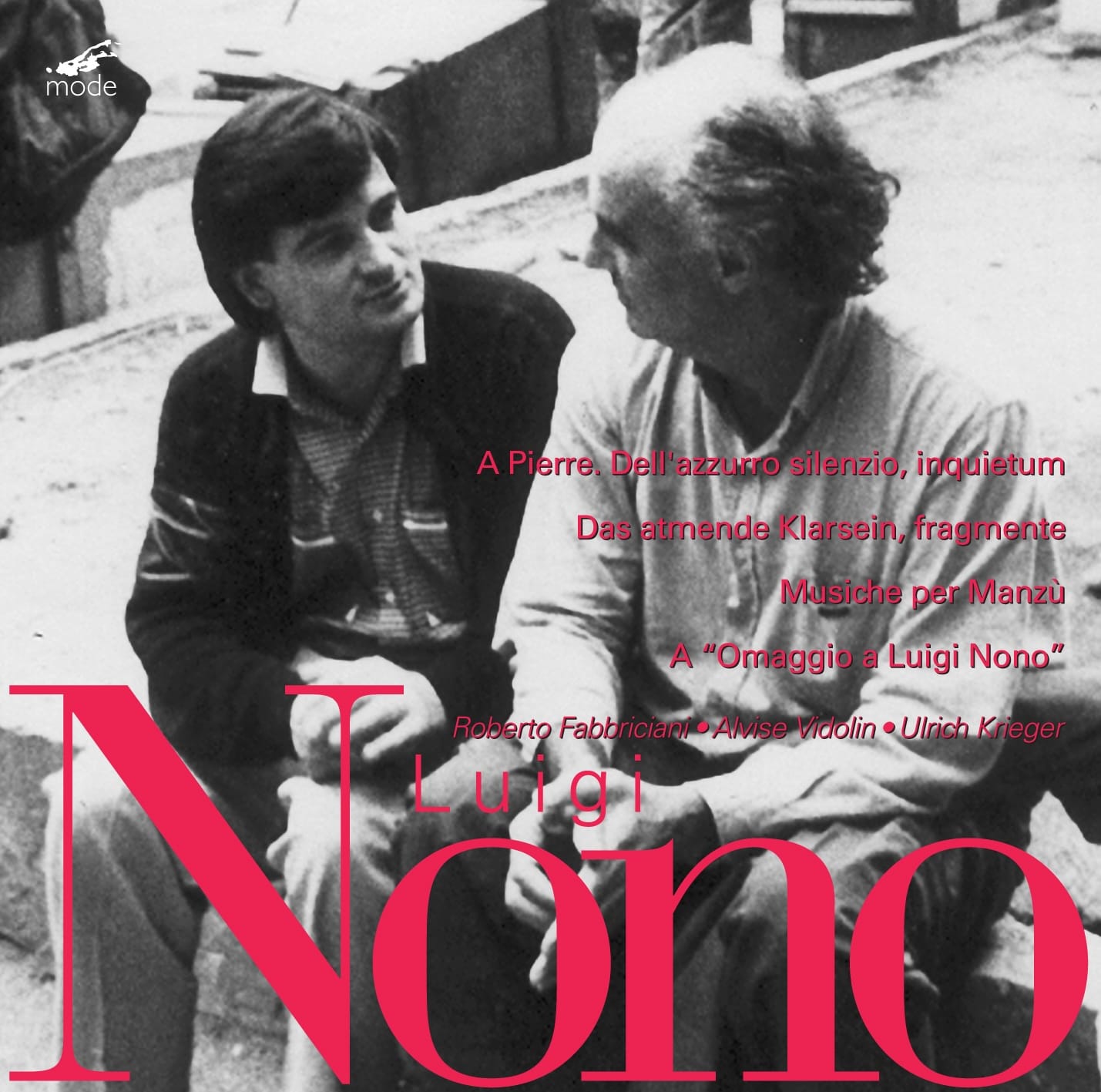
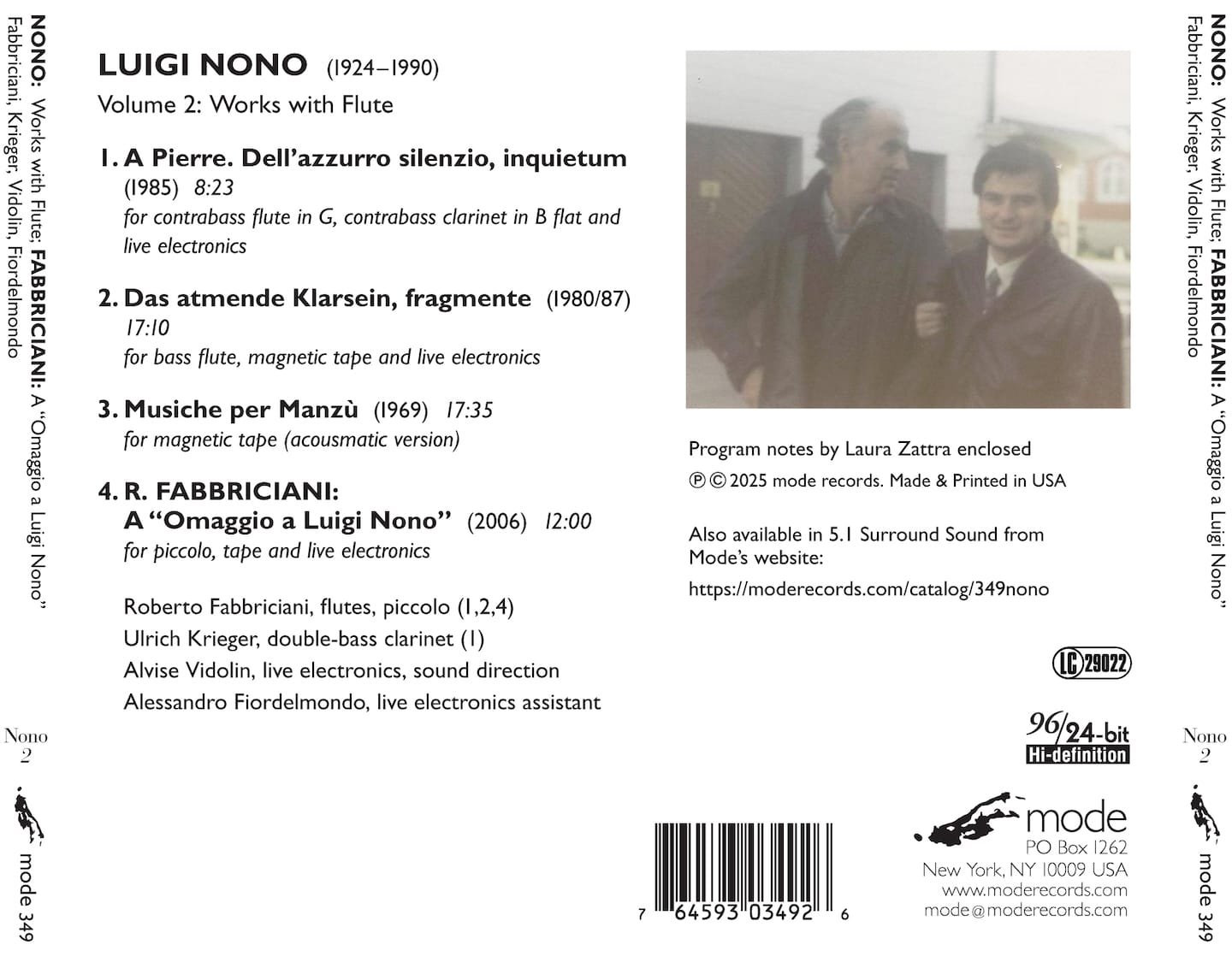

1. A Pierre. Dell’azzurro silenzio, inquietum (1985) 8:23
for contrabass flute in G, contrabass clarinet in B flat and live electronics
2. Das atmende Klarsein, fragmente (1980/87) 17:10
for bass flute, magnetic tape and live electronics
3. Musiche per Manzù (1969) 17:35
for magnetic tape (acousmatic version)
4. Roberto Fabbriciani: A “Omaggio a Luigi Nono” (2006) 12:00
for piccolo, tape and live electronics
Roberto Fabbriciani, flutes, piccolo (1,2,4)
Ulrich Krieger, double-bass clarinet (1)
Alvise Vidolin, live electronics, sound direction
Alessandro Fiordelmondo, live electronics assistant
Luigi Nono (1924 –1990) was a great innovator in the use of spatialization of sound and experimentation with performance space, non-linear time and the collapsing between sound and silence.
Beginning in 1959, he distanced himself from serial orthodoxy and the Ferienkurse compositional scene. His new works reflected a concern in political and cultural events and introduced the use of tape and electroacoustic technology.
His compositional process was increasingly involved with specific performers, whom he chose for their tone and expressive characteristics. This trust reflects on Nono’s interest in collaboration, developing the idea that traditional musical notation is limited and cannot reproduce the complexity of performance he reached with every performer.
This recording represents one of Nono’s most fruitful collaborations, the one he developed with flutist Roberto Fabbriciani during the 1980s. The track list presented here –– selected by Fabbriciani and Alvise Vidolin –– explores Nono’s music as it is defined by space (and/or the acoustic space) rather than time — the auditory impression of a labyrinthine acoustic environment in which the works seem to float on the threshold of sound and silence and seem to fluctuate from one place to another.
The creative process of A Pierre. Dell’azzurro silenzio, inquietum (1985) took place during rehearsals for the first performance of Prometeo. Tragedia dell’ascolto (Venice, 1984). Fabbriciani recalls suggesting to Nono that he should write a work, based on section VIII of Io, frammento dal Prometeo because he felt that the live electronic potential explored in that work had not been completely exploited.
The interplay between flute, clarinet and live electronics and their timbral fusion or a continuum of timbre, are at the core of the compositional process. Once the live electronic manipulation of sound moves above the threshold of silence, the listener should no longer be able to detect whether a given sound heard was produced by one of the two performers or reproduced by electronic/digital equipment.
Das Atmende Klarsein, fragmente is a reduced version of Nono’s work for small choir, bass flute soloist and live electronics. It is the first composition of the 1980s which led to Prometeo and the first outcome of the intense collaboration between Fabbriciani and Nono. In the original piece, Nono composed two distinct worlds, one of choir, the other of bass flute. As they never perform together, the bass flute part later became a solo piece after undergoing changes, cuts and transformations with the various performances by Fabbriciani (this is typical of Nono’s work in progress).
Musiche per Manzù, for magnetic tape (1969), was created for a short documentary that shows the work that Italian sculptor Giacomo Manzù did to realize the bronze doors of St. Francis church in Rotterdam. Space and spatialization are only illusory in the original version of the work, which antedates Nono’s live electronics research. But space is so deliberate here that this piece is suitable to live electronics interpretations. Alvise Vidolin re-interprets Musiche per Manzù using the original mono version published by Ricordi, with a multichannel 5.1 surround sound system.
A “Omaggio a Luigi Nono”is Fabbriciani’s tribute to his collaboration and friendship with Luigi Nono. The tape part has been recorded by Fabbriciani at the Experimental Studio of the Heinrich-Strobel Stiftung in Freiburg, the same studio where he worked with Nono in his important sound research for a decade. It contains the natural acoustic sounds of the piccolo. It explores this instrument and reflects Fabbriciani’s research on extended yet simple sounds.
A “Omaggio a Luigi Nono”is also an homage to the last years of their friendship, which culminated in the piece Post-praeludium n. 3 “BAAB-ARR”. “We got as far as the Post-praeludium n. 3 “BAAB-ARR”, structured on a single note with all its possible universes. After the performance in the Kammersaal of the Berlin Philharmonie on 4th September 1988 Gigi [Luigi] smiled and said to me, “the next time I’ll write less!” (Fabbriciani, 1999). The score is so non-existent and deprived of any meaningful indications to any flutists but Fabbriciani that the Committee for the Edition of the Works of Luigi Nono set up by Casa Ricordi has decided to withdraw it from the catalogue.
A “Omaggio a Luigi Nono”by Fabbriciani reflects both his own research on extended techniques, and Nono’s reduction to the essential nature of sound and music. The acoustic part interacts with the tape part made with prerecorded piccolo sounds. The assembling, mixing and spatialization of the recorded sounds is conceived by Alvise Vidolin.
Liner notes by Laura Zattra.
Download the Article: Alessandro Fiordelmondo. Studio production report for “Das Atmende Klarsein – Fragmente” by Luigi Nono, recorded in 2018 at the Contro di Sonologia Computazionale (CSC) at the University of Padua. July 10, 2019. Mode Records.
Download the Article: Alessandro Fiordelmondo. Studio Production Report for “A Pierre. Dell’azzurro silenzio, inquietum” by Luigi Nono, recorded in 2018 at the Contro di Sonologia Computazionale (CSC) at the University of Padua. July 10, 2019. Mode Records.